
Ask a business development team why they lost their last big pursuit, and you'll usually hear about price, the interview or the incumbent.
Those reasons are real. But for many AEC firms, the outcome was shaped weeks earlier, in decisions that never made it onto anyone's agenda: which pursuits to chase, who followed up, and what the team learned from the last one.
Full pipelines don't pay the bills. Won work does.
The difference usually comes down to a few habits, not a bigger list of opportunities.
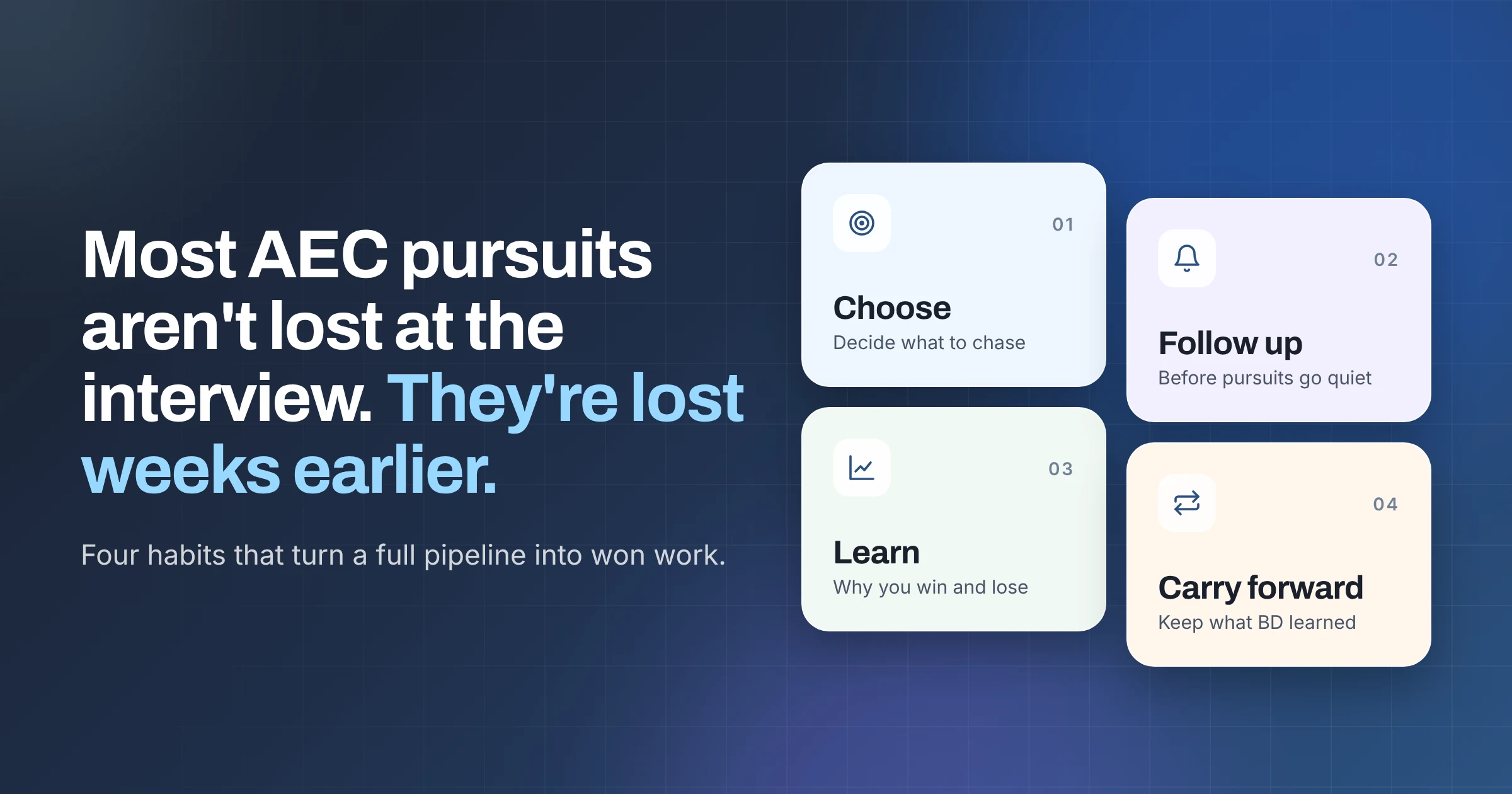
These are the four habits that separate firms that track opportunities from firms that win them:
01
Choose
Decide what to chase, and record why.
02
Follow up
Catch pursuits before they go quiet.
03
Learn
Know why you win and why you lose.
04
Carry forward
Keep what BD learned when the work is won.
1. Decide What to Chase, and Write Down Why
Every pursuit costs time from people who are also delivering projects. Yet many go/no-go decisions still happen in a hallway or an email thread, and the reasoning disappears with them.
Firms that pursue selectively make go/no-go a recorded decision. They score the same few factors every time and keep the answer on the opportunity itself.
Common go/no-go factors include:
- Strength of the client relationship
- Relevant experience the firm can show
- Staff availability for the project
- Expected margin
Why it matters
Over time, that record shows which pursuits were worth the effort and which ones never had a real shot.
2. Catch Pursuits Before They Go Quiet
Pursuits rarely die in a meeting. They go quiet: nobody follows up, the RFP drops, and someone else got there first.
The fix isn't more meetings. It's a short, shared list of the pursuits that need attention this week.
Three questions that list should answer:
- Which active pursuits has nobody touched lately?
- Which submissions are due in the next 30 days, and does each one have an owner?
- Which opportunities have no client contact attached?
When the weekly pipeline meeting reviews that list instead of every card, follow-up becomes routine instead of heroic.
3. Learn Why You Win and Lose
"We lost on price" is often a guess. Without a consistent record, every postmortem starts from memory.
A short, specific list of reasons, filled in every time a pursuit closes, turns individual outcomes into patterns. Price, relationship, schedule, qualifications and incumbent are a good starting point. Ten clear reasons are easier to report on than thirty overlapping ones.
The payoff
Leadership can see which sectors, clients and delivery methods to lean into, and which to stop chasing.
4. Keep What You Learned When You Win
The moment a pursuit is won is often when knowledge gets lost. BD knows the client, the team and the history. Operations starts from scratch.
When the won pursuit becomes the project, carrying its contacts, team and files with it, delivery starts with everything BD learned.
And the finished project becomes ready-made past experience for the next proposal, instead of a hunt through shared drives for photos, project descriptions and resumes.
The Common Thread: One Source of Truth
None of these habits needs a big new process. They need one place where relationships, pursuits and project history live together, so the people delivering today's work can help win tomorrow's.
Choose. Follow up. Learn. Carry forward.
Simple habits, applied consistently, are what turn a full pipeline into won work.
That's what ProjectMark is built for: a CRM made for AEC firms that connects relationships, opportunities and projects, so business development, marketing and operations work from the same picture.
See it in action
Watch how AEC firms put these habits to work
Get the full ProjectMark walkthrough: go/no-go, follow-up, win/loss tracking and project history, all in one CRM built for AEC.
Watch the demo